

AI systemsbuilt to operate.

Revenue, service, and operations systems—shaped through the product experience,
AI, data, integrations, and controls required to work in practice.

Start with the business bottleneck

Three systems buyers recognize.
One connected delivery practice.

A strong project does not begin with “we need an agent.” It begins with a valuable decision, service journey, or recurring workflow that is currently slow, fragmented, or unreliable.

Independent studio · remote-first · worldwide

01

Demand arrives. Context gets lost.

Revenue systems

For property, professional-service, SaaS, and other high-consideration businesses with valuable inbound demand.

Connect the customer journey to qualification, account context, pipeline state, proposals, follow-through, and attribution.
Useful first build

A measured lead journey from one acquisition source to one accountable CRM-ready outcome.

  • Journey and signal map
  • Qualification and routing rules
  • CRM-ready account context
  • Ownership, follow-up, and measurement states
02

The answer exists. Access and handoff fail.

Service & knowledge systems

For teams with repeated questions, fragmented documentation, missed messages, or uneven service across languages and channels.

Connect approved knowledge, search, chat, voice, email, and messaging to routing, escalation, consent, evaluation, and service reporting.

Useful first build

One bounded assistant or service journey evaluated against realistic questions, sources, and escalation cases.

  • Approved-source and answer model
  • Conversation and channel flow
  • Escalation and consent rules
  • Evaluation cases and service reporting
03

Work repeats. State and ownership disappear.

Operations systems

For teams coordinating important work through spreadsheets, inboxes, manual copying, status chasing, and disconnected admin tools.

Connect intake, data, policies, agents or automation, operator views, permissions, notifications, audit context, and reporting.

Useful first build

One recurring workflow made visible from intake through completion, including exceptions and operator control.

  • Current-state and exception map
  • Workflow and permission model
  • Operator interface and automation
  • Audit context, monitoring, and runbook

Working evidence / two useful interfaces

Do not trust the category list.
Inspect the behavior.

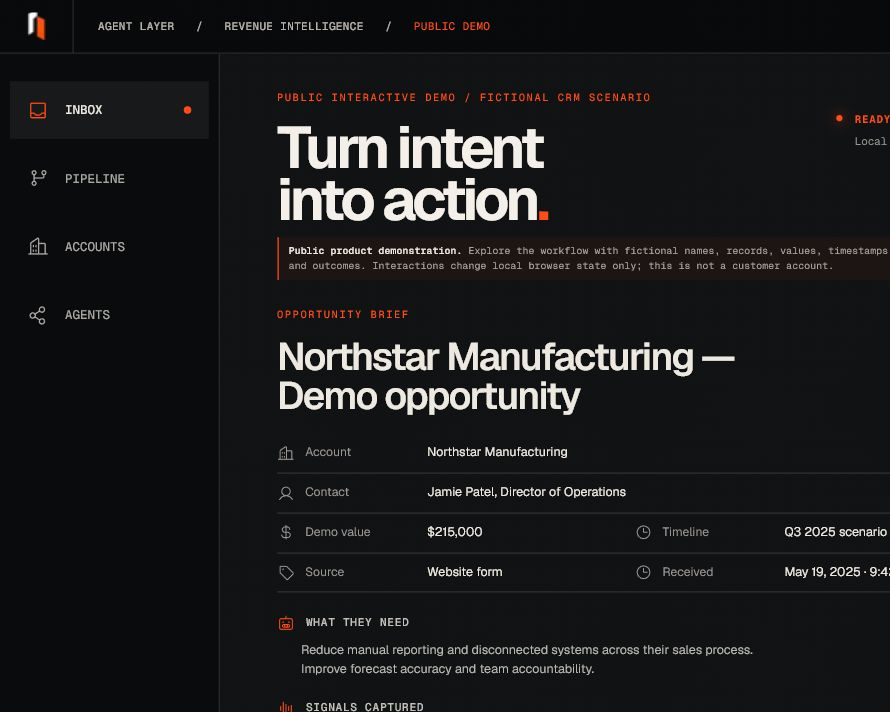
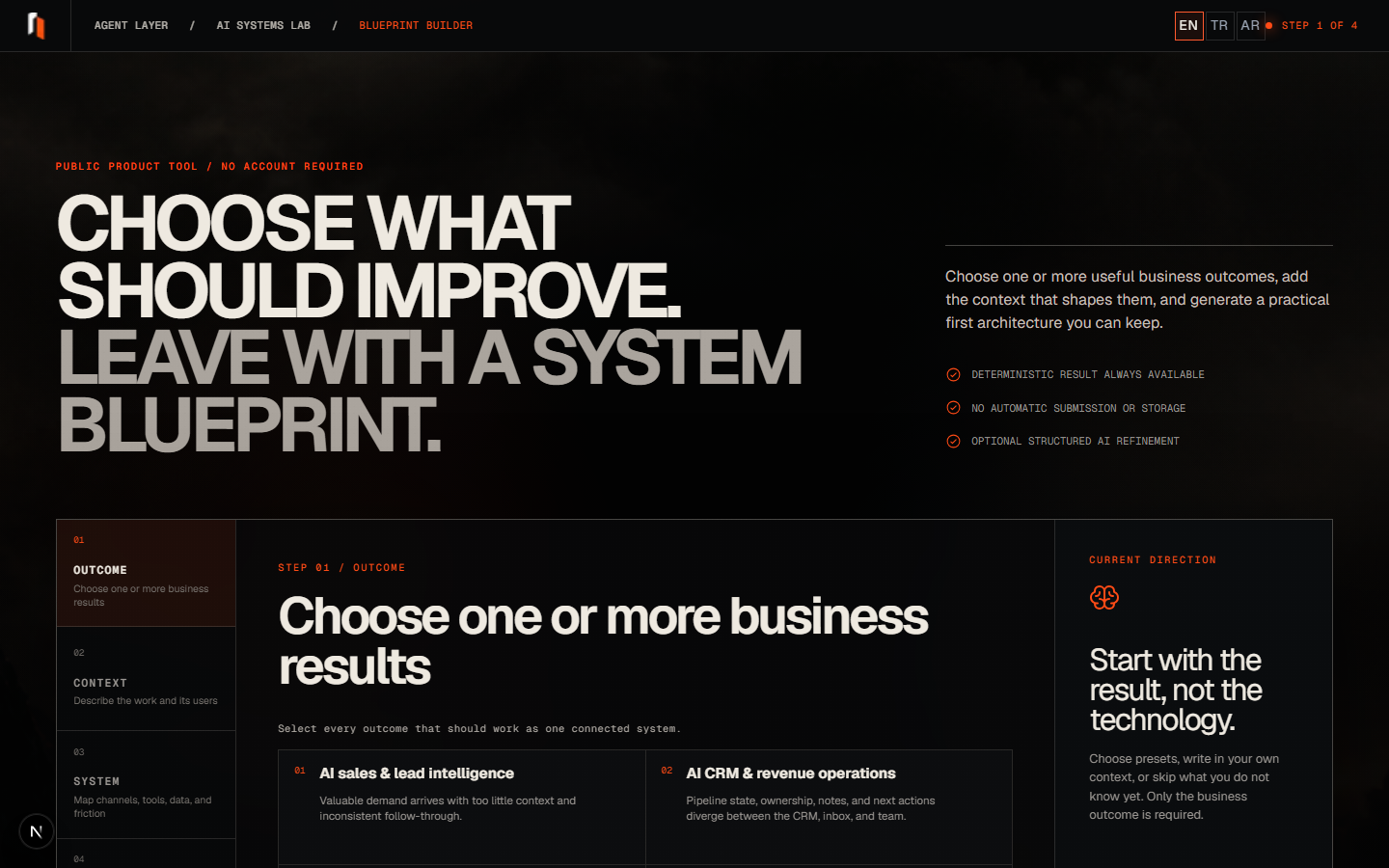
The revenue environment proves implemented workflow interaction with fictional data. The AI Systems Lab produces a real, downloadable planning artifact from visitor-supplied context. Neither is presented as a client deployment or measured commercial result.

Read the complete evidence records
01 Implemented and testable

Revenue workflow / working demo

See demand become a decision-ready opportunity.

Inspect fictional website intent, qualification context, a CRM-ready draft, and the local state behind the next action.

Open the revenue demo
02 Functional and local-first

AI Systems Lab / practical builder

Turn your bottleneck into a system blueprint.

Choose an outcome, describe the workflow and tools, then generate a local blueprint with a first build, system map, controls, integrations, and production gaps.

Build your blueprint

Evidence before autonomy. Public demos make their data, state, sources, and execution boundary visible. Production work adds real permissions, evaluation, observability, recovery, and ownership around the business action.

The trust system / visible project artifacts

Know what will be delivered.
Know what each artifact proves.

Trust is not a row of security words or partner logos. It comes from making the decision, architecture, working behavior, verification, limitations, and operating ownership inspectable.

  1. 01

    Decision brief

    Define the business problem, user decision, current workflow, constraints, baseline, and success evidence before choosing technology.

    What it provesThe project is solving an agreed problem—not buying a fashionable tool.

  2. 02

    System map

    Show interfaces, data, models, tools, integrations, permissions, owners, and failure paths in one readable view.

    What it provesScope and responsibility are visible before implementation expands.

  3. 03

    Working increment

    Build the smallest end-to-end slice that real users can inspect with realistic cases and reversible states.

    What it provesThe core journey works before more channels, agents, or automations are added.

  4. 04

    Verification record

    Record functional, accessibility, performance, security-boundary, data, and failure-path checks relevant to the system.

    What it provesRelease decisions are based on evidence rather than a polished presentation.

  5. 05

    Operating handoff

    Document environments, ownership, configuration, runbooks, known limitations, recovery, and the next measurement plan.

    What it provesThe system can be operated, maintained, and improved after launch.

Connected delivery layers

Broad capability.
Bounded by one business outcome.

Experience, intelligence, and operations are not separate upsells. They are the parts of the system that earn their place when the problem requires them.

01

Experience

Turn complex offers into clear, credible experiences.

Premium websites, digital products, customer portals, ecommerce, and interactive experiences designed around what people need to understand and do next.

Inspect the layer
02

Intelligence

Make business knowledge useful at the moment of need.

AI assistants, agents, search, voice, and messaging systems that can answer from approved knowledge, qualify requests, complete defined tasks, and hand off cleanly.

Inspect the layer
03

Operations

Move work from signal to completion.

CRM, automation, internal tools, data systems, backends, and integrations that keep customer context, ownership, and execution connected across the business.

Inspect the layer

Market reality / source-backed, not self-reported

Demand is growing.
So is the cost of getting it wrong.

These findings explain the studio model. They are external market context—not Agent Layer performance claims, revenue projections, or guarantees.

01

AI integration demand grew 178% year over year in Upwork's 2026 marketplace analysis.

Businesses are buying applied integration inside existing work—not model access in isolation.

Upwork In-Demand Skills 2026 · February 2026 Upwork marketplace data is U.S.-demand weighted and does not predict Agent Layer revenue.
02

Most organizations still have difficulty moving from AI pilots to scaled impact.

Workflow redesign, adoption, trust, measurement, and operating ownership are part of the product.

McKinsey State of AI 2025 · November 2025 Global survey findings describe the market; they are not a performance benchmark for a specific project.

Engagement path / decisions before expansion

Diagnose. Prove.
Productionize. Improve.

Each stage must earn the next. Exact scope, timing, price, integrations, and regulatory obligations follow the evidence in the project brief—not a generic package.

Worldwide collaboration

Bring the bottleneck.
Leave with a bounded next decision.

For founders, operators, product teams, agencies, and hiring leaders. Start with the result that matters, the current workflow, the people involved, and the evidence required to trust a release.